
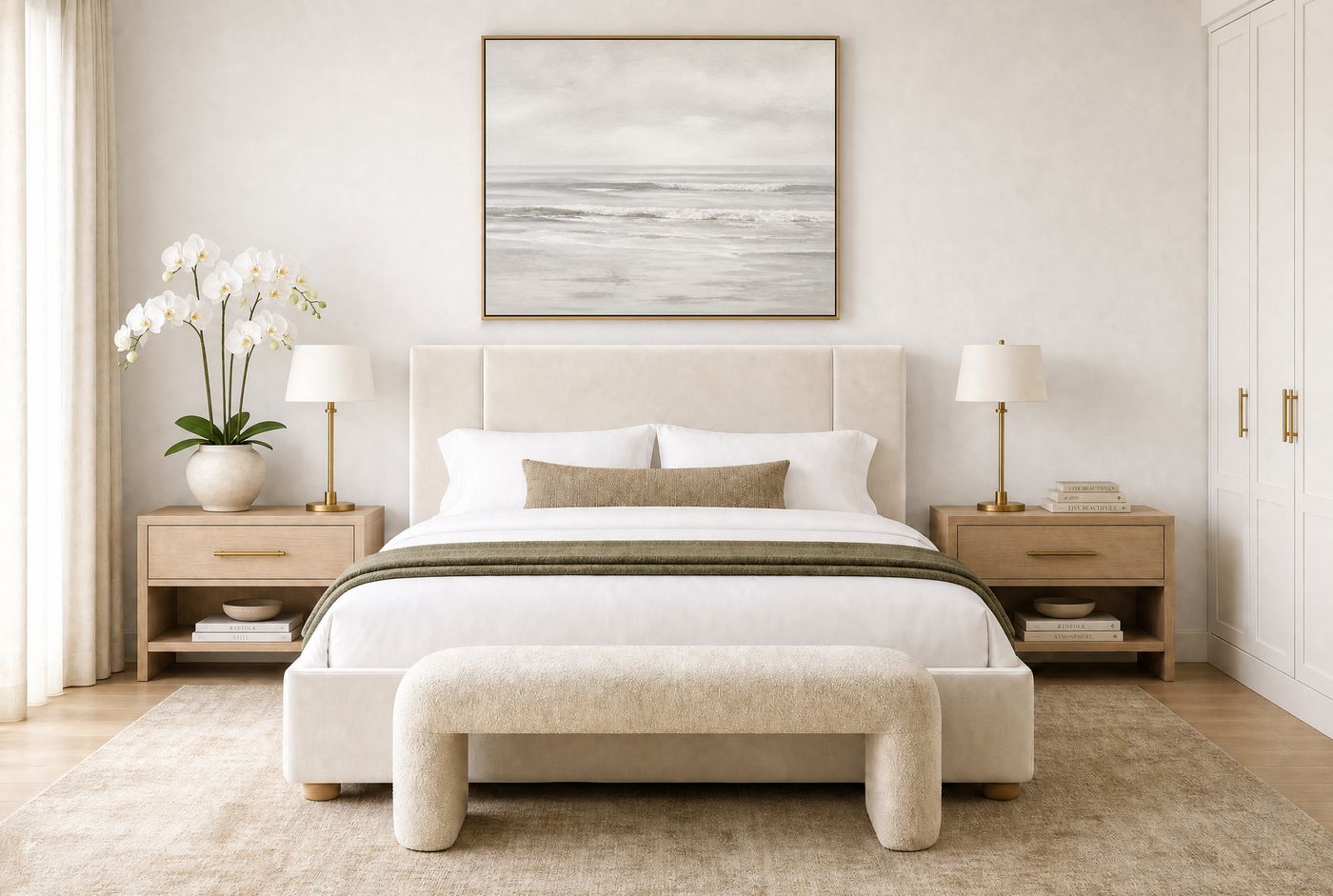
Art is where rooms most often go wrong at the last step. The piece is beautiful, the wall is right, and then it gets hung twenty centimeters too high and the whole room quietly falls apart. Height and scale are the two decisions that matter, and both have numbers, so let me give you mine.
The height
On an open wall, I hang art with its center at 152 centimeters from the floor. Most people hang higher than this, usually because they hang relative to their own eye line while standing, and rooms are lived in sitting down as much as standing up. When art sits a little lower than instinct suggests, it connects to the furniture and the people instead of hovering above them. If you take one number from this post, take that one.
Above furniture, the logic changes: the art relates to the piece below it, so it sits a hand's width or a little more above the sofa back, the console, the headboard. Close enough to belong to it, high enough to breathe.
The scale
The second number is two thirds. Art hung above a piece of furniture wants to be around two thirds of that piece's width. Above a three-seat sofa, that's a substantial work, and this is where most walls fail, because most people buy art that's too small for the wall it lives on. A small piece floating alone above a big sofa reads as an apology. If one large work isn't possible, group smaller ones so that the group reaches that two-thirds width together.
Groups and pairs
When I hang a gallery grouping, the spacing does the work: 5 to 8 centimeters between frames, kept consistent through the whole arrangement. Consistent gaps make different frames and different sizes read as one composition. I also like a group of two or three smaller pieces in portrait orientation, especially above a bed, where a stack of verticals calms a wide wall.
Playing with scale on purpose
Everything above is the reliable path. But one of my favourite moves goes the other way: a deliberately small artwork over a large piece of furniture, paired with a sconce on each side. The sconces carry the width, the small work becomes a jewel between them, and the contrast reads as a decision rather than a shortage. This works because everything else about the wall is composed. Break the scale rule only when you're clearly breaking it on purpose.
Before you make holes
My honest advice: tape first. Cut paper to the size of the artwork, tape it to the wall, and live with it for a day. Walk past it in morning light and evening light. The tape costs nothing, and it has saved me from more wrong walls than any rule has. Then hang once, at 152, and enjoy the fact that you'll never wonder about it again.