
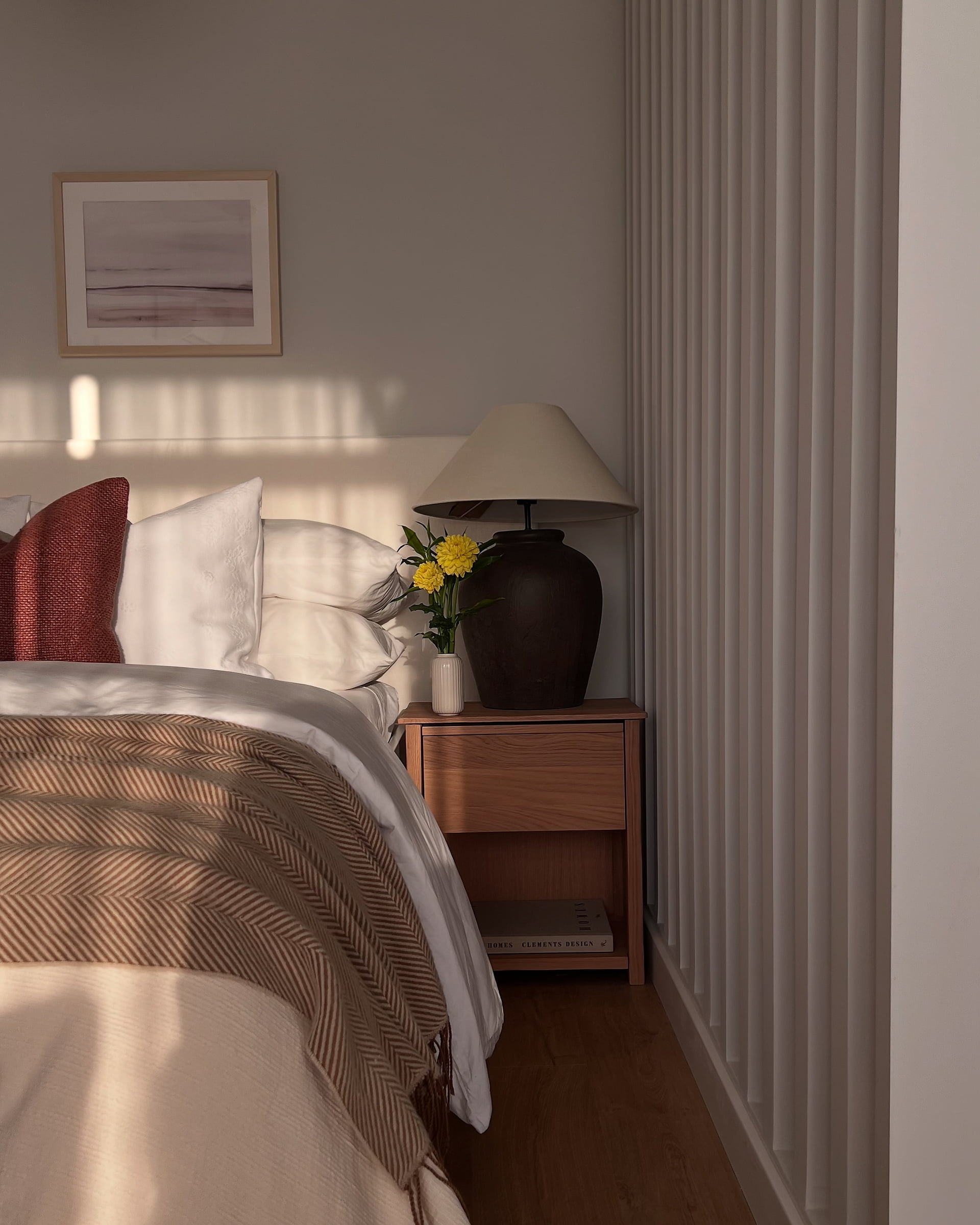
Property staging is the preparation of a specific home for its sale: furniture selection and ordering, installed and styled on site, then photographed for the listing. The audience is a buyer who will spend two minutes in the space and a few seconds on each photograph. Everything in staging works on those two windows.
What it is at our studio
We run staging as a nine-step process across four phases, and the short version goes like this. We see the property and decide what it needs to compete in its own building and area. We select the furniture and place the orders. We install and style everything on site, down to the smallest surface. Then the home is photographed for the listing, because in Dubai the photograph is the first viewing and often decides whether there is a second.
A question we get every time: what happens to the furniture. The furniture is bought at cost and it is yours. It stays with the home and conveys with the property at sale, which buyers increasingly expect in this market. The styling props that appear in photography are the exception: those are borrowed for the shoot and returned. Our fee covers the work around the furniture: the sourcing, the vendor coordination, the order placement, the installation and the styling.
What staging does to a sale
The honest answer is that it changes the comparison. A buyer walking through your home has usually just walked through others, and in this market that often includes a developer's show apartment: finished, styled, lit, and empty of anyone else's life. Staging closes the distance between your listing and that standard.
We measured what that distance looks like in our own register work: inside the same Dubai building, at the same bedroom count, sales sit about 29 percent apart, the finding of Same building, same size, 29% apart. Condition and presentation are far from the only things inside that gap, but they are the part a seller can still move after the building, the floor and the view are already fixed.
Independent data points the same way. In the National Association of Realtors' 2025 profile, 29 percent of agents reported offers between 1 and 10 percent higher on staged homes, and 49 percent observed reduced time on market. We cite that survey because it discloses its method; we avoid the bolder numbers that circulate in this industry without one.
What staging never does
Staging involves no concealment. It never covers a defect, and an inspection finds what an inspection finds. A staged home is the same home, presented with intention.
It also differs from interior design, which is our other service and a different job: design is for the people who stay, worked out over months around how they live. Staging is for the people deciding, built for the two minutes and the photographs. The two share taste and discipline. They serve different audiences on different timelines.
And it differs from virtual staging. When we show a rendered image anywhere, we label it a design visualisation. A staged room is real: you can walk through it, the light in the photographs is the light in the room, and the buyer's two minutes happen inside it.
When we would tell you to skip it
Some homes should go to market as they are. A home that is already beautifully furnished and photographs well may need styling adjustments at most. A property being sold for its land or priced for full renovation gains little from furniture. And an off-plan resale competing purely on payment terms is a different conversation. Staging earns its keep where the home is empty, or where the furniture that lived a family's life is not the furniture that sells a house. When it will make no difference, we say so at the site visit.