
Styling is the part of design everyone thinks they can skip, and it's where finished rooms are actually made. The furniture is the sentence structure, but the objects are the tone of voice. Here's how I style the flat surfaces of a home, and the small rules that keep them from tipping into clutter.
My starting principle
I keep the soft things calm and let the hard surfaces carry the character. Sofas, bedding, curtains, the big textile moments stay quiet. Then every styled surface, the coffee table, the shelf, the console, gets one small surprise. One object with a story, an odd shape, a texture that doesn't quite behave. I like little surprises. A room without any feels like a showroom. A room with too many feels like a shop. One per surface is the dose.
Coffee tables
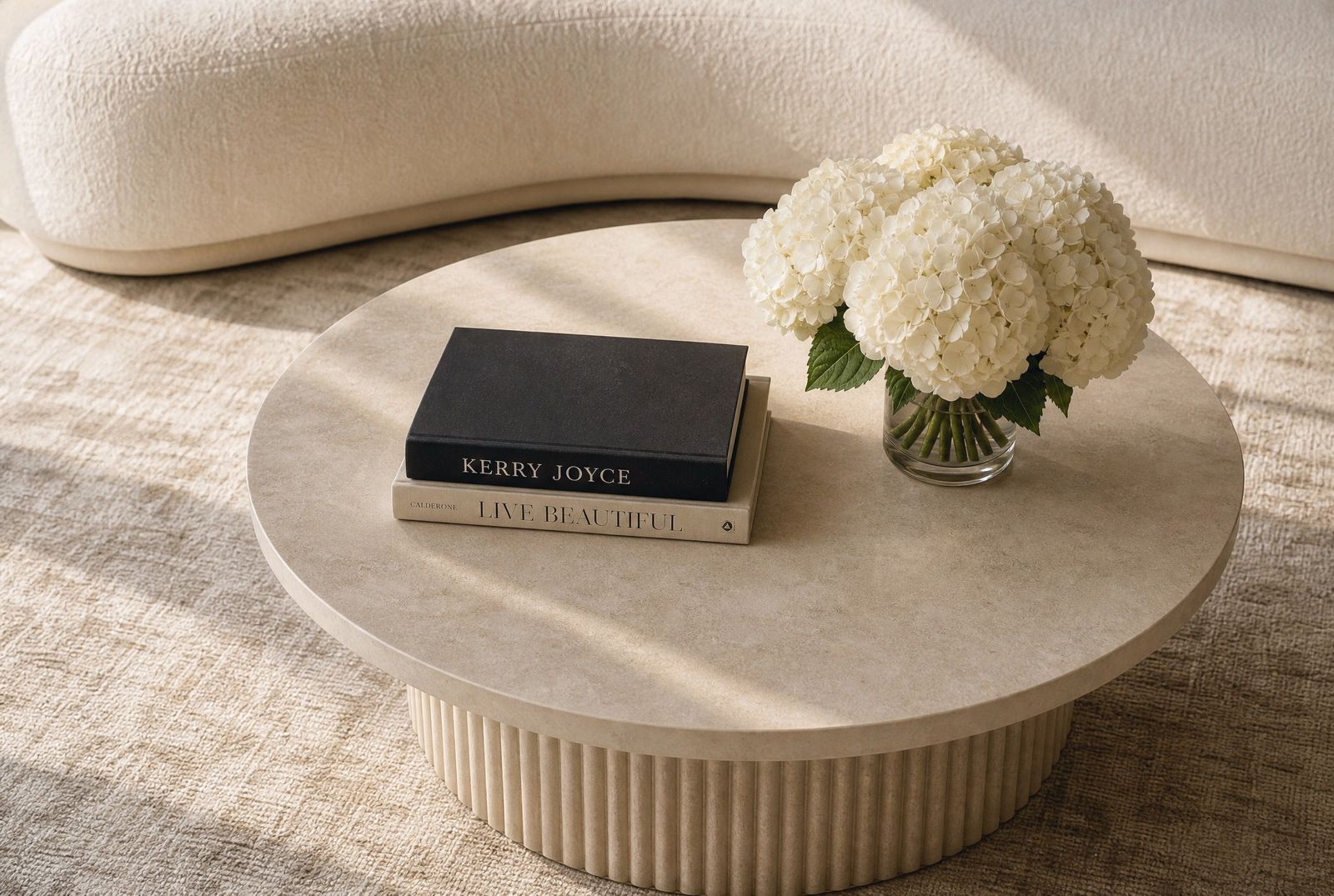
I build coffee tables in odd numbers. A tray as the base, because a tray corrals the objects into one deliberate composition and gives the eye a boundary. Then a grouping of three or five things at different heights, a stack of books, something sculptural, something alive. I mix rounded shapes with rectangular ones so the table doesn't read as a grid. And then the test that actually matters: I sit in every seat around the table and look. A coffee table is seen in the round, from above, from the side, from the corner of the sofa, and it has to hold up from all of them. If it only works from one angle, it's styled for a photo, and you don't live in a photo.
Shelves
Shelves are where I'm strictest about the method. I empty everything. All of it, on the floor, sorted by size, and I give myself a blank shelf to work with, because old arrangements pull new decisions toward them and you end up rearranging your mistakes instead of starting fresh.
Then the largest pieces go in first, staggered across the shelves so the visual weight moves diagonally rather than stacking in one column. Everything after that enters in groups of two or three, never as a line of soldiers. Books get to lie down as well as stand. And when it's done, I walk away and come back with fresh eyes, because the second look always finds two things to remove. Feeling restless after the first pass is normal. The second pass is where shelves are actually finished.
Kitchen counters
Kitchens earn a special rule because their surfaces work for a living. I strip the counters completely, then let things back one by one only if they pass a double test: it gets used, and it's beautiful. The olive oil you cook with every day in a bottle you like looking at passes. The gadget you use twice a year fails, no matter how it looks. And then I allow exactly one thing back purely for its beauty, a bowl, a vase, a piece of ceramic, because a kitchen that's all function reads as cold, and one beautiful freeloader is what makes it a room instead of a workstation.
Flowers and greenery
Whatever holds flowers relates to the surface it stands on, in scale and in weight, and the arrangement itself should be full and alive. A single stem in a large vase reads as an afterthought. Go generous or go without, and without is a real option, because an empty surface with one good object beats a crowded one every day.
The finishing thought
The goal of all of this is a home that looks inhabited by someone with a point of view. Lived-in beats staged, always. A stack of books that's actually being read, a tray that moves because people use it. Style the surfaces, then let life disturb them a little. The disturbance is part of the design.