
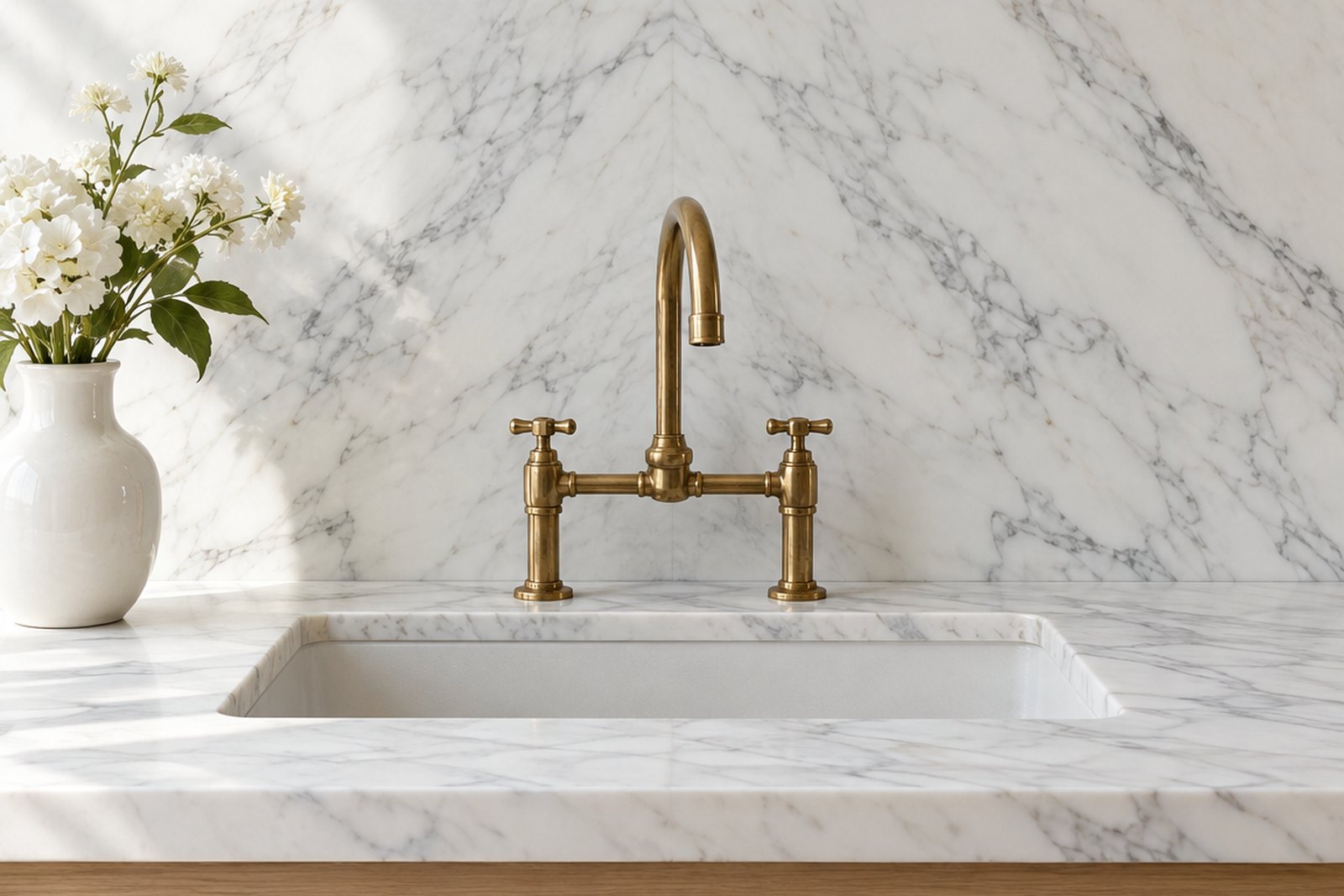
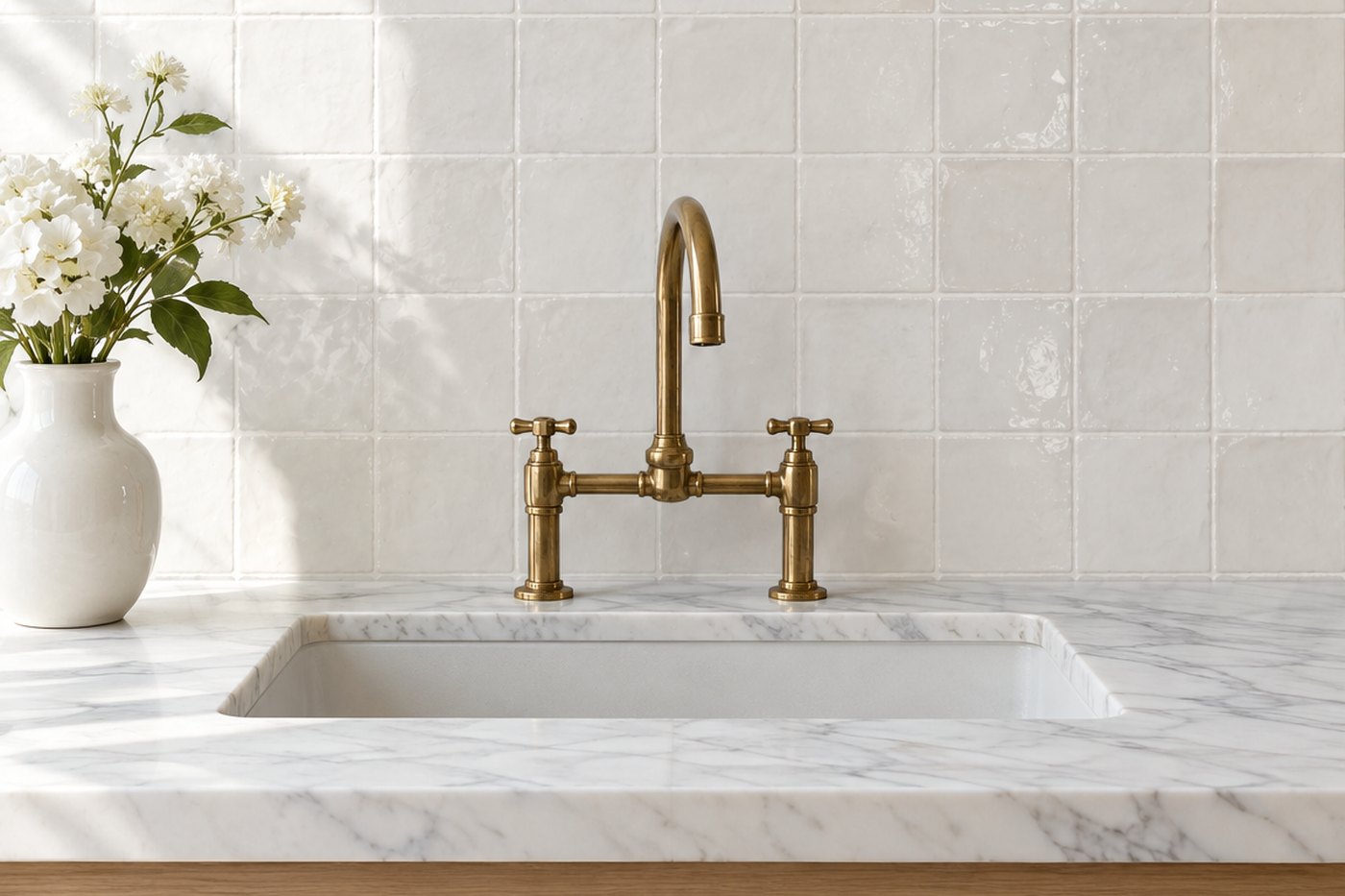
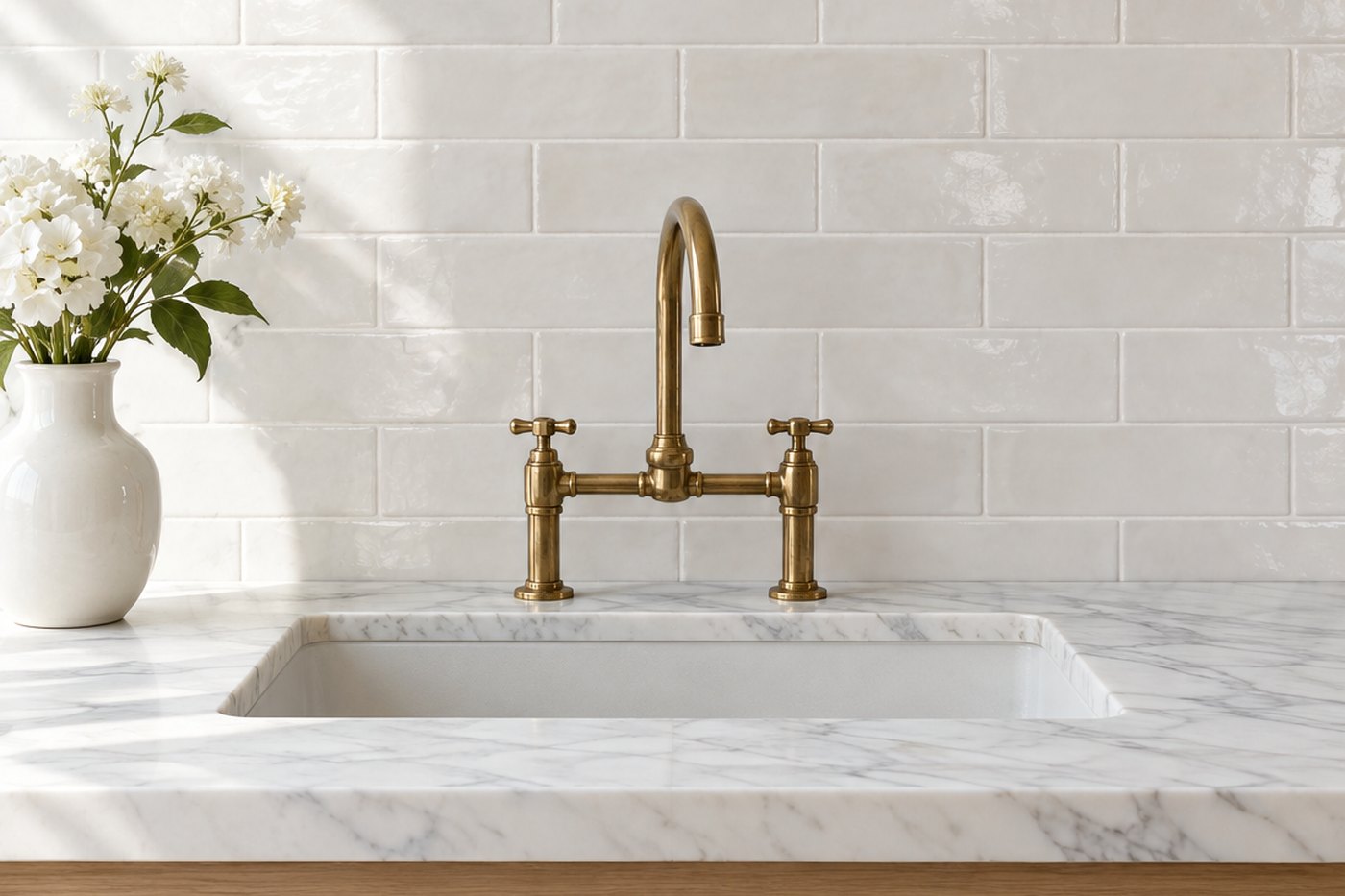
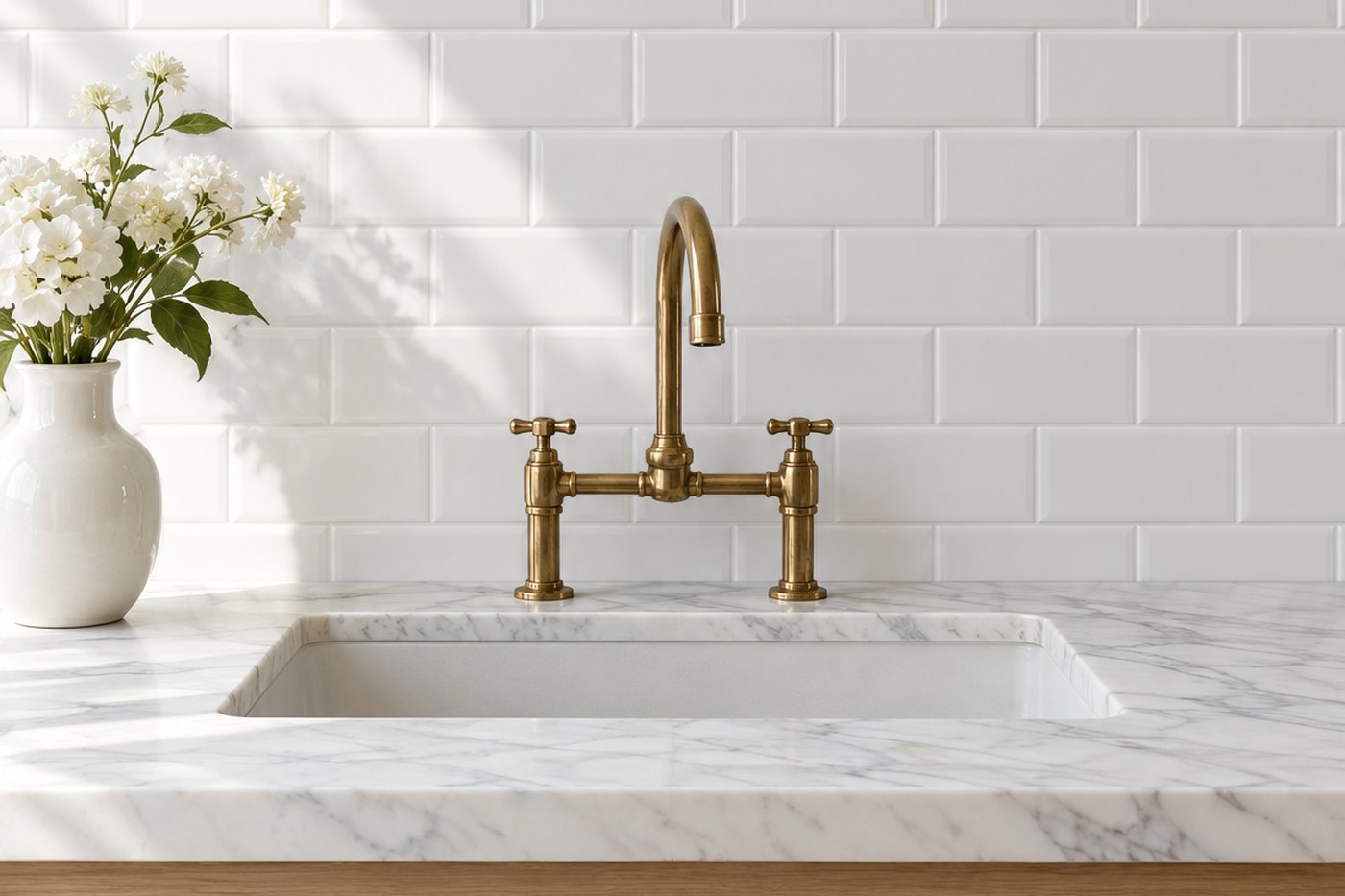
In these images the sink, the brass tap, the marble countertop and the oak cabinets stay exactly the same, and only the wall behind them changes, from a single slab of Calacatta to handmade zellige and two ways of laying a subway tile. Seeing them side by side makes it clear that the tile alone can move a kitchen from classic to relaxed to architectural.
A full slab of stone
A slab that runs up from the counter has no grout lines at all, so it reads as one calm, continuous surface and lets the veining become the artwork of the room. Book matching, where two consecutive slabs are opened like the pages of a book so the veining mirrors at the joint, gives the effect in the first image. Marble etches with lemon juice and vinegar and needs sealing, so behind a busy hob I either welcome the patina or choose a quartzite or a porcelain slab with a similar look.
Zellige
Zellige is handmade glazed terracotta from Morocco, and every tile differs slightly in thickness, tone and surface, so the wall catches the light in a way a machine made tile never does. Square zellige feels soft and artisanal, while the long rectangular tile laid in a brick pattern is a little more relaxed and suits a kitchen that leans traditional. Its irregular edges need wider grout joints, and I always keep the grout close to the colour of the tile so the surface reads as one.
Subway tile, stacked or offset
The same smooth white rectangle changes completely with the way it is laid. Stacked in a straight grid with every joint aligned, it looks architectural and modern, and offset by half a tile in the classic running bond it becomes the pattern most people picture in a traditional kitchen. Subway is also the easiest of these surfaces to clean and to repair, which makes it a sensible choice for a kitchen that is cooked in every day.
Grout, height and light
Grout colour changes a tiled wall more than people expect, because matching grout lets the wall settle back while contrasting grout draws every line. I take the backsplash at least to the underside of the wall cabinets, and on an open sink wall like this one I run it all the way up, because a backsplash that stops halfway can make a room feel lower. A glossy tile such as zellige or glazed subway also bounces daylight around the kitchen, which matters in a room with only one window.
How I decide
I look at the countertop first. If the counter is strongly veined, I keep the wall simple or continue the same stone up behind it, and if the counter is plain, the wall can carry the character. A matching slab behind a marble counter is one of the most beautiful things a kitchen can have, but it asks for very little else around it, while zellige brings warmth to a white kitchen and subway keeps everything crisp so the joinery and the hardware can lead.
The images in this article are design visualisations by Studio Sakaia.