
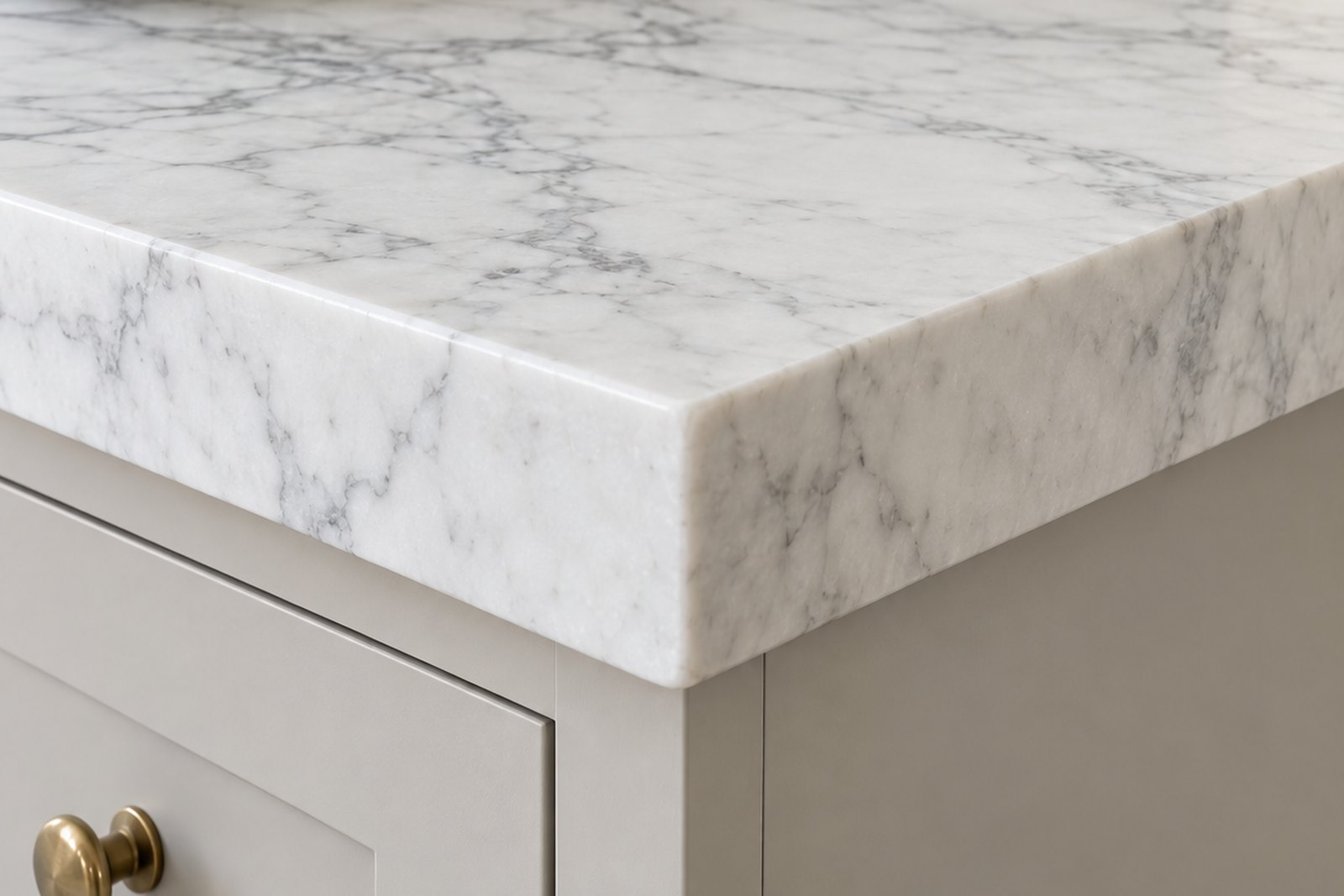
When clients choose stone, they spend weeks on the slab and a few minutes on the edge, yet the edge is what decides whether a beautiful piece of marble reads as crisp and contemporary or soft and traditional. In the images here the kitchen, the light and the Calacatta stay exactly the same and only the profile of the edge changes, which makes it easy to see how much those last few centimetres do.
The simple edges: eased and bevelled
An eased edge is a square edge with its sharp corners just softened, so it feels clean under the hand and keeps the slab looking crisp. It is the one I use most in modern kitchens, because it leaves all the attention on the veining. A bevelled edge cuts a small angle along the top, which catches the light as a fine line and gives the slab a little more definition without changing its mood.
Half and full bullnose
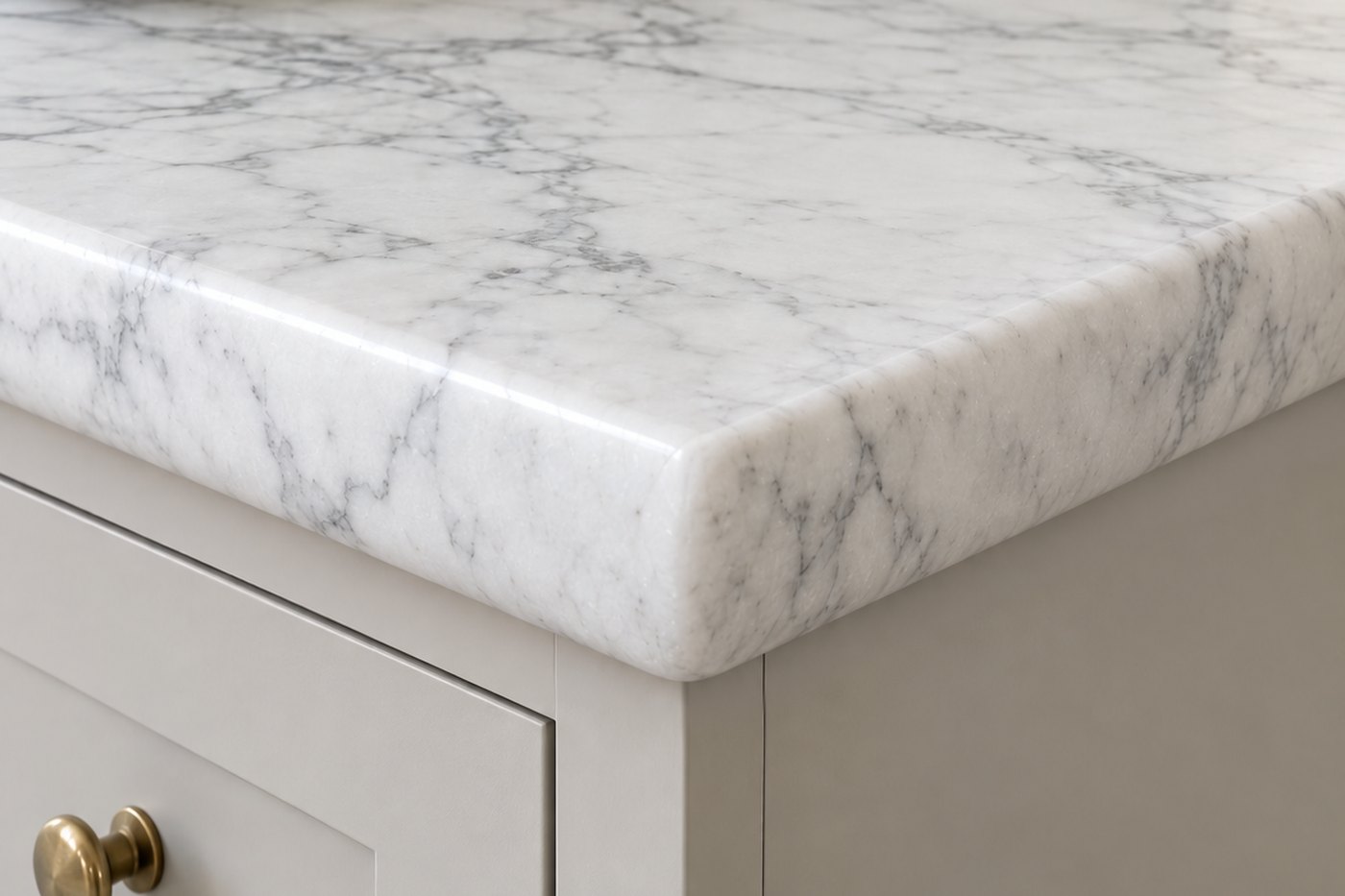
A half bullnose rounds the top of the edge and keeps the underside flat, while a full bullnose rounds both, so the edge reads as one soft curve. Both are kind to hips and to children running past, and both sit most naturally in a traditional or relaxed kitchen. In a crisp contemporary space a full bullnose can look heavy, so I keep it for rooms that already have softer lines.
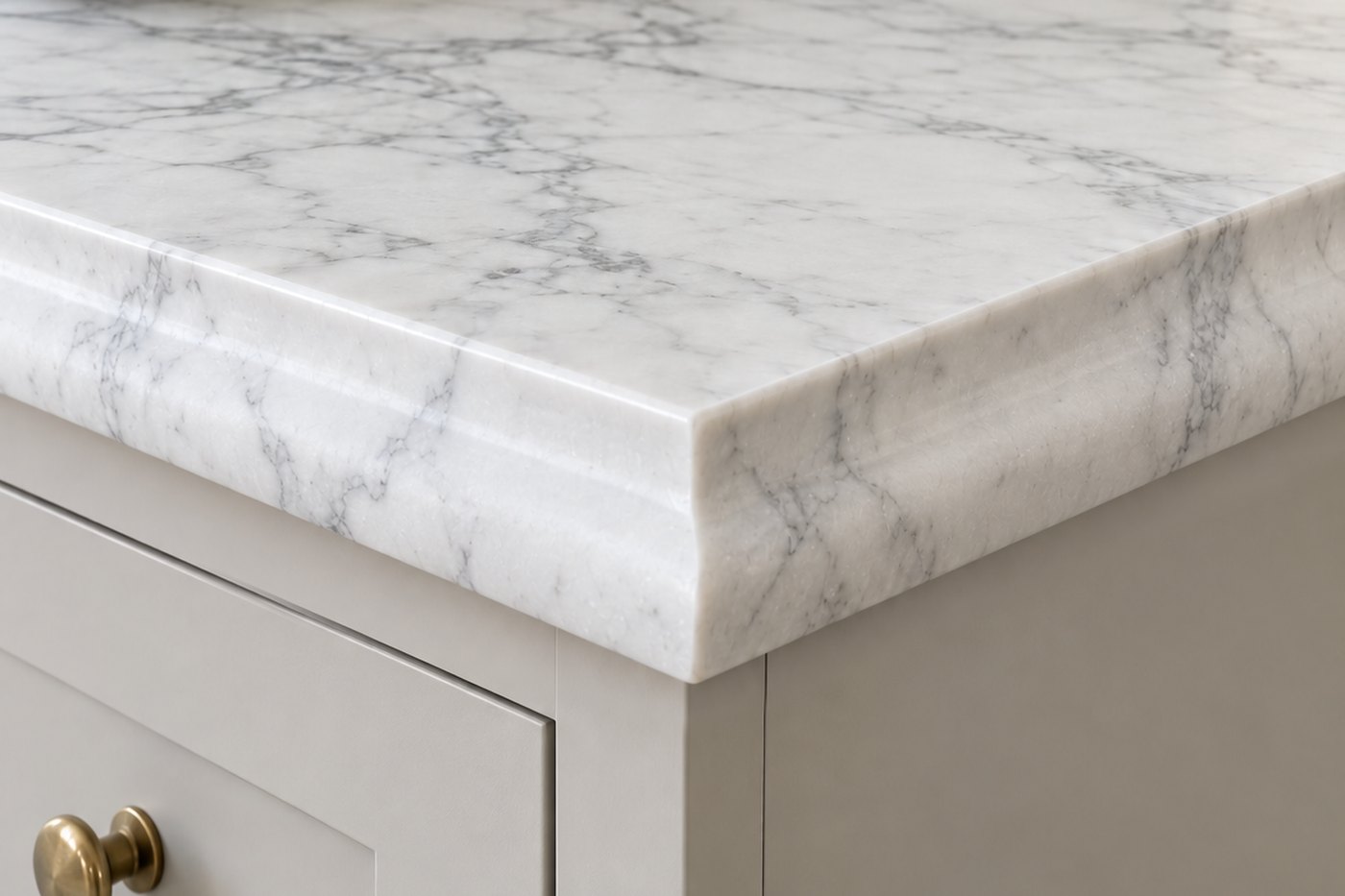
Ogee, the classic edge
An ogee carries an S shaped curve along the face of the stone, and it is the profile you find in older houses and in kitchens with Shaker or beaded doors, cornices and traditional hardware. I would not choose it for most kitchens, but for a classic one it is the edge I come back to, because it gives the stone the same level of detail as the joinery around it. The curve collects a little more crumb and dust than a flat edge, so it suits a household that is happy to wipe along it.
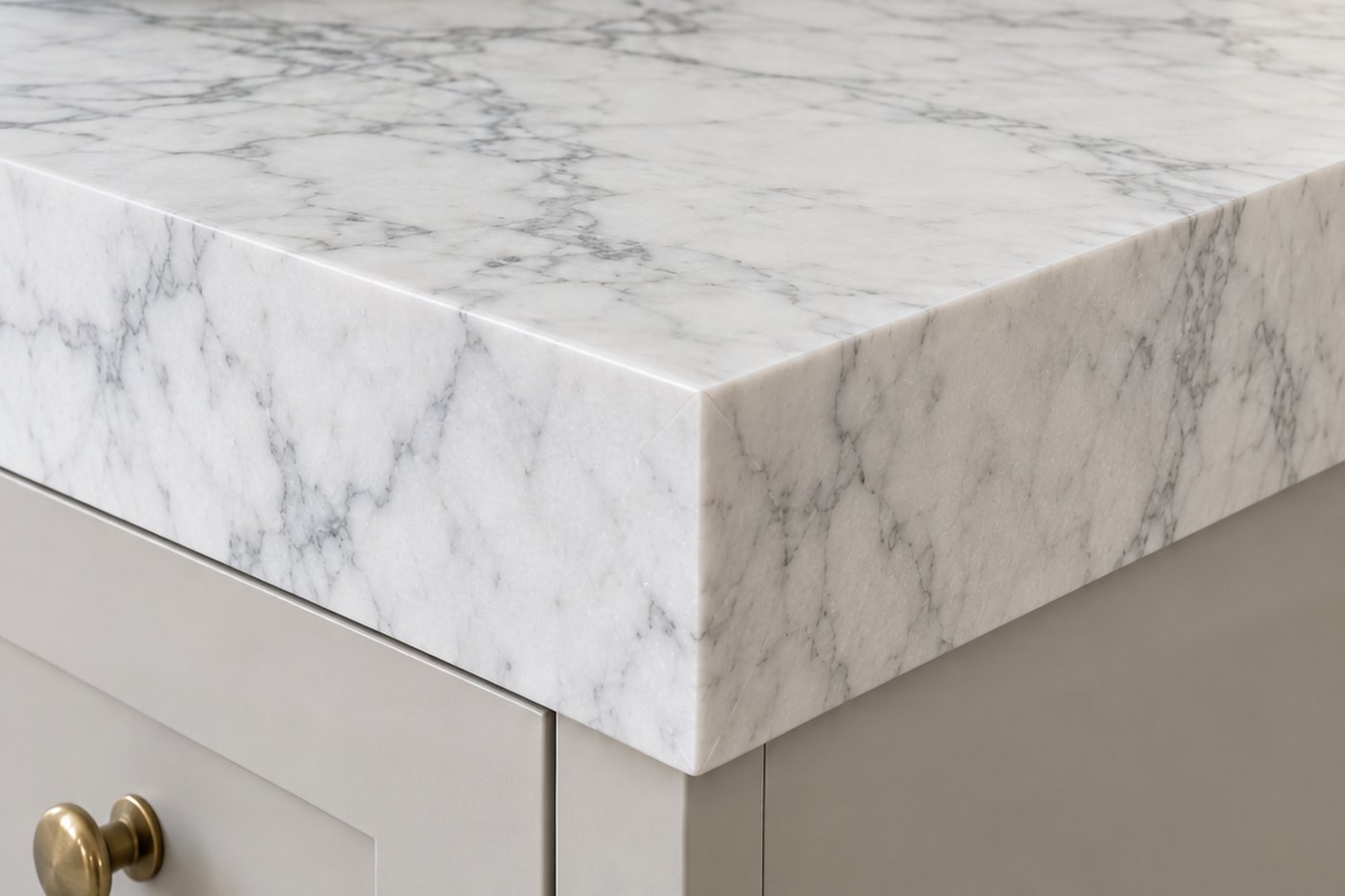
Mitred apron, the look of a thicker slab
A mitred apron joins a second strip of stone to the front of the slab at a 45 degree angle, so a 2 cm slab reads like a solid block of 4 to 6 cm and the veining turns the corner with it. It is the profile for an island, or for a modern kitchen that wants the stone to feel substantial, and it needs a skilled fabricator, because a poor mitre joint shows at once.
Reeded, texture on the edge
A reeded edge cuts fine vertical grooves into the face of the slab and works in the same way as reeded joinery, adding texture and shadow without adding another colour. It is lovely on an island or a bar, though the grooves take more care to keep clean, so I use it where it will be admired more than where it will be worked hardest.
Practical points before you decide
Marble chips most easily at sharp corners and thin edges, so a softened profile is more forgiving in a family kitchen. The thickness of the slab changes how every profile reads, and the same ogee looks delicate on 2 cm stone and generous on 3 cm. An edge is also much easier to judge in your hand than in a picture, so I always ask the fabricator for a small sample cut in the chosen profile before the slab is templated.
How I decide
I start from the doors and the hardware, because the edge should belong to the same family as the joinery. Flat slab doors and integrated handles lead me to an eased or mitred edge, Shaker doors sit happily with an eased, half bullnose or ogee edge, and a classic kitchen with cornices and beaded inset doors is where an ogee feels right.
The images in this article are design visualisations by Studio Sakaia.