
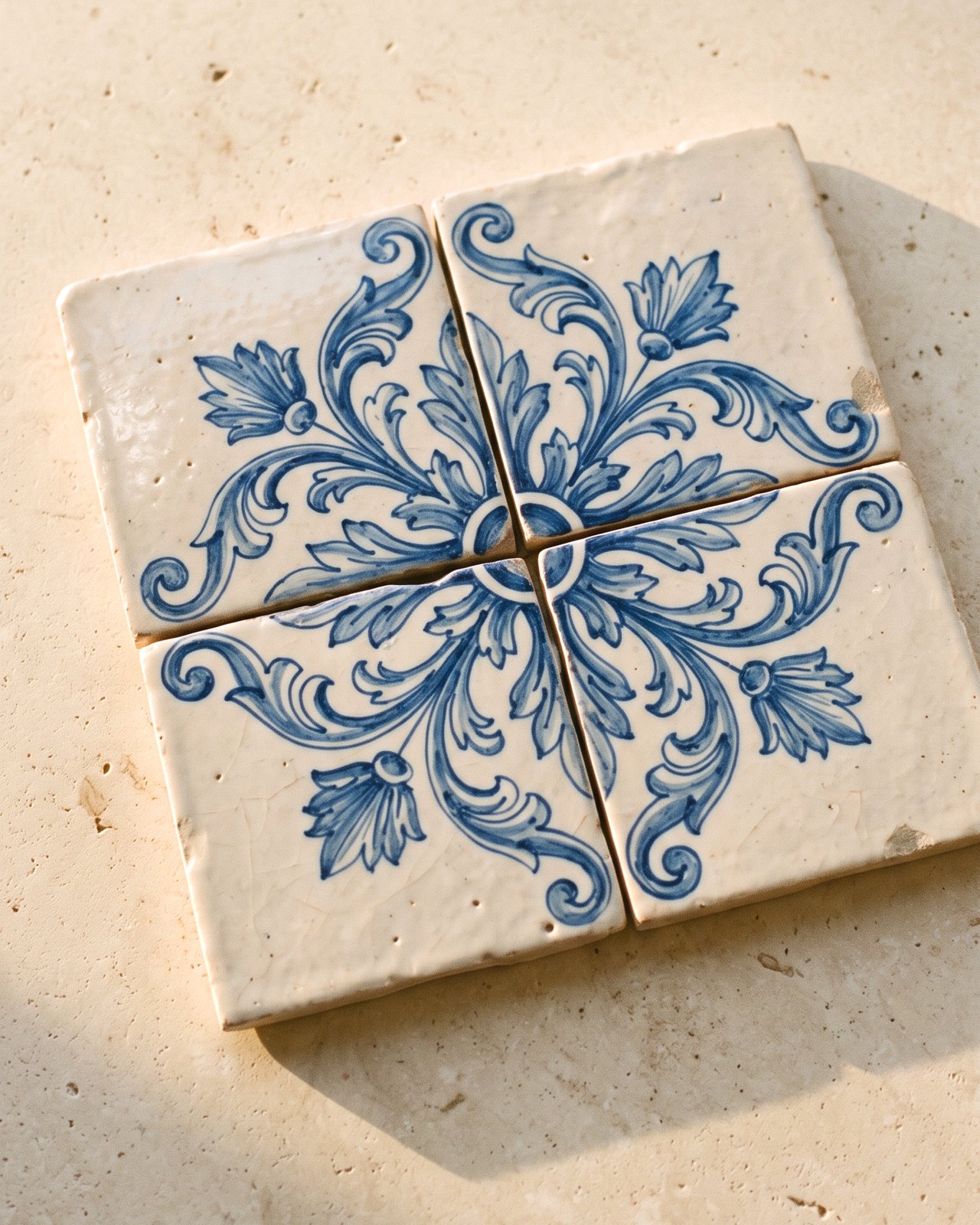
In the images here the same four tiles sit on the same limestone in the same afternoon light, and only the tile changes, from Lisbon to Samarkand to a Romanian village stove. Seen side by side, it is easy to understand how much history a single square of glazed clay can hold.
Azulejo, Portugal
The blue and white azulejo is the tile most people picture when they think of Portugal, painted in cobalt on a white glaze and laid across facades, church walls and stairways. Four tiles often join into one larger motif, so the pattern only reveals itself once the wall is complete. In a kitchen or a bathroom it brings a calm, graphic freshness that suits white joinery and pale stone.
Zellige, Morocco
Zellige is made in Fez from glazed terracotta that is cut by hand into small pieces and set together into stars and interlocking shapes. Because every piece is chipped and fitted by a craftsman, the surface catches the light unevenly and never looks mechanical. A full zellige wall is strong, so I often use it on a single feature, such as a fountain, a niche or the wall behind a basin.
Iznik, Türkiye
Iznik tiles were made for the Ottoman court, painted with tulips, carnations and long curving leaves in cobalt, turquoise, green and a famous deep tomato red. They still line the interiors of Istanbul's great mosques and palaces. Their colour is rich enough to carry a room on its own, so I like them framed by plain plaster and simple stone.
Cuerda seca, Spain
Cuerda seca, which means dry cord, is a technique from Islamic Spain that Seville made its own. A fine dark line is drawn on the tile before glazing, and it keeps each colour of glaze in its own field, so the colours sit side by side without running together. The result is a jewel-like pattern with a slightly raised surface that looks beautiful on a stair riser or a small splashback.
Talavera, Mexico
Talavera comes from Puebla and takes its name from Talavera de la Reina in Spain, whose potters brought the craft across the Atlantic. It is tin glazed earthenware painted by hand, most often in cobalt and yellow, with a thick, slightly raised blue that you can feel under your fingers. It brings warmth and a sense of celebration to a kitchen or a covered terrace.
Maiolica, Italy
On the Amalfi Coast the town of Vietri sul Mare has painted ceramics for centuries, and its tiles are as bright as the coast itself, with lemons, leaves and the blues of the sea. Maiolica is the most joyful tile in this set, and it works best in generous light, on a terrace, a pantry wall or a kitchen that opens to the garden.
Girih, Uzbekistan
Girih is the art of interlacing geometric lines into stars and polygons, and in Samarkand it covers domes, portals and courtyards in turquoise and cobalt glaze. The pattern is precise and almost endless, which gives it a calm, meditative quality. A small panel of girih in an entrance or above a fireplace feels both architectural and personal.
Cahle, Romania
In Romanian homes the tile lived on the stove. Cahle are glazed stove tiles, moulded in relief with flowers, birds and folk motifs, and for generations they kept houses warm through the winter. In a deep bottle green they are some of the most beautiful tiles I know, and a few of them set into a modern wall carry that warmth and memory into a new home.
How I use patterned tile
A handmade tile needs space around it to be seen, so I let one pattern lead and keep everything near it calm, with plain plaster, honed stone and simple joinery. Small areas often do more than whole walls: the splashback behind a range, a powder room floor, a run of stair risers or a single niche. I keep the grout close to the background colour of the tile so the pattern reads as one surface, and I always order samples, because the irregular glaze and the depth of colour can only be judged in real light.
How I decide
I start from the house and the people who live in it. A tile from a place that means something to the family, a country they come from or a journey they love, always feels more right than a pattern chosen only because it is in fashion. Once that story is clear, the colours of the room usually follow from the tile.
The images in this article are design visualisations by Studio Sakaia.