
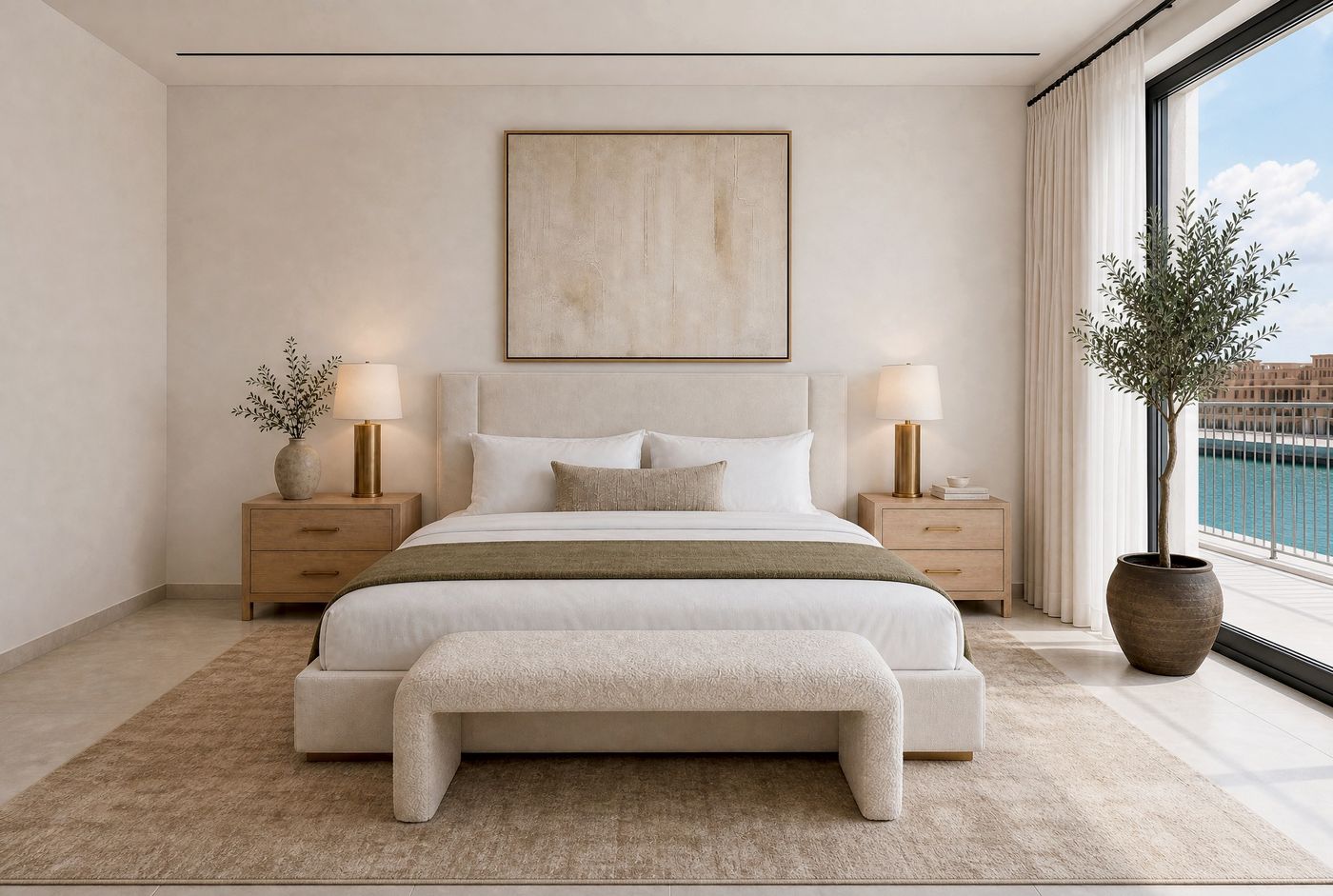
A wrong rug is the fastest way to make a good room feel off, and the frustrating part is that most people can't tell what's bothering them. The furniture is right, the colours are right, and still the room feels somehow thin. Nine times out of ten, the rug is too small. So let me share the numbers I actually work with, room by room. Write them down before you shop, because in the showroom everything looks bigger than it will feel at home.
One shape
I always go rectangular. Round rugs and organic shapes photograph nicely, but in a real room they fight the geometry of the furniture, and calm comes from things agreeing with each other. A rectangle under a rectangular arrangement lets the eye rest.
The living room
In a living room, I like the rug to hold the whole seating group together. The way I do it: the front two legs of every sofa and chair sit on the rug. That's enough to connect the group. The exception is anything with a flat base, an ottoman or a swivel chair. Those go on the rug entirely, because a flat base sitting half on and half off looks slanted, like the piece is sliding away. And a rug with all the furniture pushed off its edges reads like an island, with the seating floating away from it.
My numbers: the rug extends at least 15 centimeters beyond the sofa on each side, and 30 is what I aim for. Between the rug and the walls, I leave somewhere from 20 to 60 centimeters of floor showing, so the room keeps a border of breathing space. The rug follows the length of the longest sofa, and the coffee table sits about 45 centimeters from the sofa's edge, close enough to reach, far enough to walk.
The bedroom
In a bedroom, the rug goes under the lower two thirds of the bed, perpendicular to it, with a generous amount showing at the foot. I don't run it under the nightstands, and I don't run it under the dresser either. Those stand on the floor, the rug belongs to the bed. But here's the test that decides whether the placement is right: when you get out of bed in the morning, your feet should land on the rug, never on a cold floor. So leave enough rug showing on each side of the bed to catch that first step. For sizes, with a queen bed I'd start at 8 by 10 feet, and with a king I'd start at 9 by 12. Bigger works, smaller rarely does, because a rug that fails the morning test has missed its whole reason for being there.
The dining room
Dining rugs have one job: the chairs. All four legs of every chair stay on the rug even when someone pulls the chair out to sit down. In practice that means the rug extends about 90 centimeters past the table on every side. Less than that, and the back legs drop off the edge every time someone stands up, and you'll hear it and feel it daily.
Which rug, once the size is right
Size is only the first gate. When I'm choosing the rug itself, I check two things. First, its colours need to tie back to something already in the room, the sofa, the curtains, the art. Second, its pattern weight runs opposite to the rest of the scheme. A calm, quiet room can carry a rug with real pattern in it. A room that already has pattern in the fabrics wants a quieter rug. When both the rug and the room are loud, nobody wins.
And when I'm torn between two sizes, I take the bigger one. Every time. A rug that's slightly too generous reads as intentional. A rug that's slightly too small reads as a mistake, and it's the one mistake everyone's eye can feel, even when they can't name it.