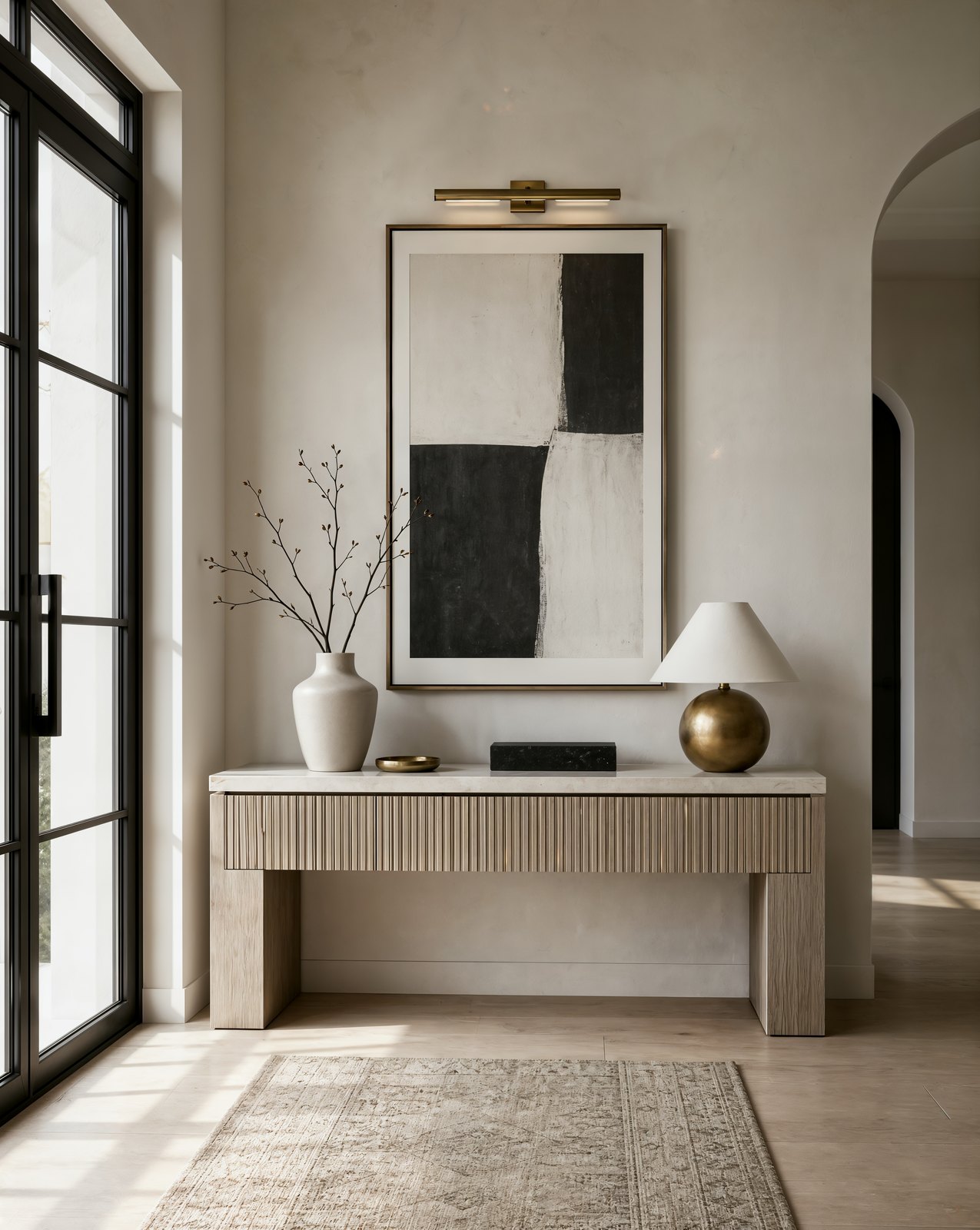
Most art in most homes is the wrong size, and the reason is simple: people buy the nearest standard size, and the nearest standard size is almost never the right one for the wall. A wall has a specific width, a specific height, a specific piece of furniture beneath it and a specific eye level in front of it. The chance that a mass-produced print in a standard frame matches all of that is low, which is why so many rooms have art that is a little too small, hung a little too high, framed in something that does not quite belong. Making a piece to the wall it will hang on removes the compromise entirely.
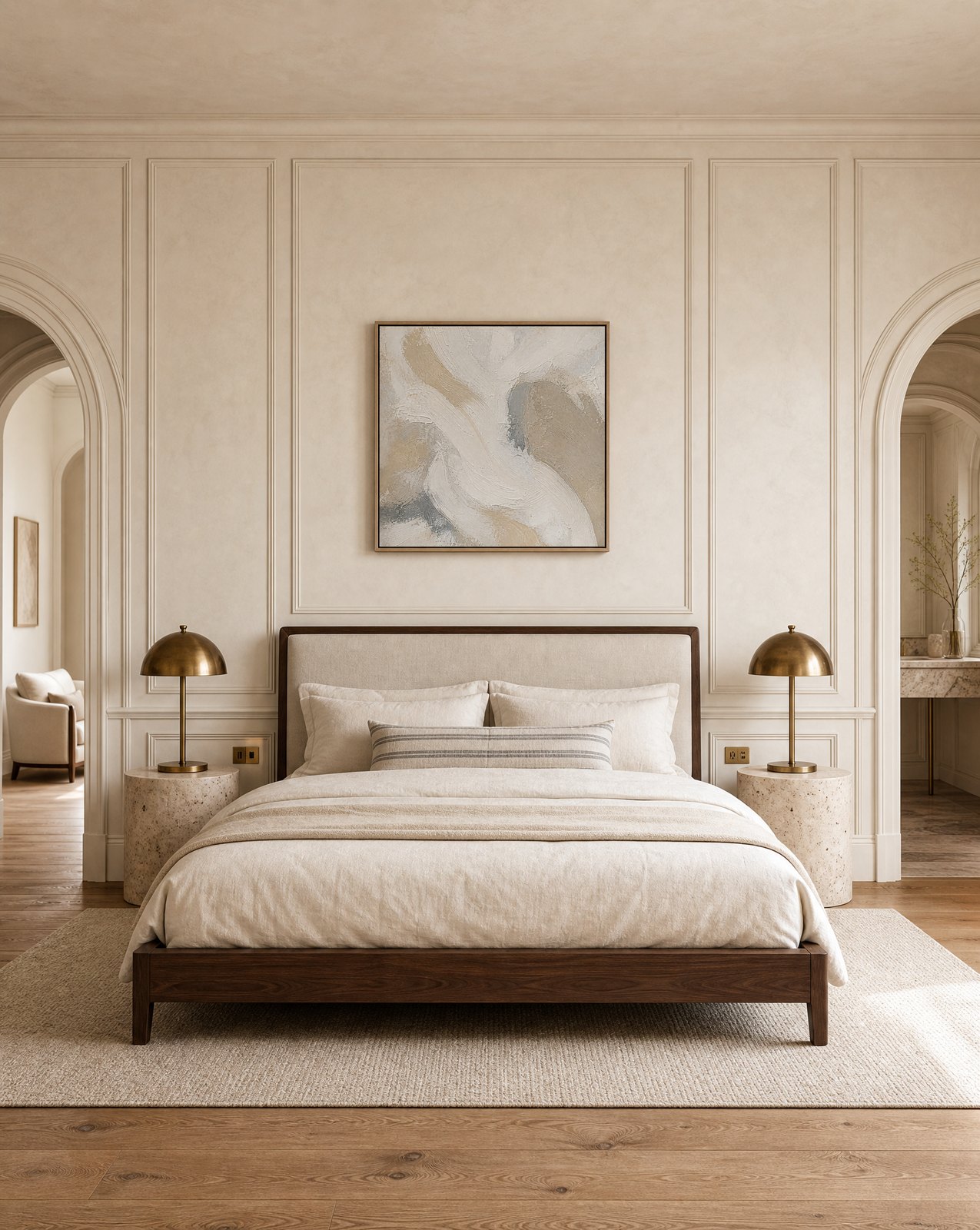
The short case for made-to-order art is that scale is the difference between a piece that anchors a room and one that floats on it, and scale is exactly what you cannot control when you buy off a standard rack. A piece sized to two thirds of the wall below it, in proportions that match the wall's shape, framed to sit with the room, and hung at the right height, does something a correctly-chosen-but-standard piece struggles to: it looks inevitable, as though the wall and the art were designed together, because they were.
Why standard sizes fail a specific wall
Standard art comes in standard formats: certain widths, certain aspect ratios, certain frame profiles. Walls do not. A Dubai living room might have a three-metre stretch above a long console, a tall narrow pier between two windows, a double-height void over a stair. None of these is a standard proportion, and forcing a standard piece onto them means accepting a compromise: a piece too small for the three-metre wall, a landscape format on a wall that wanted a portrait, a frame that fights the room's palette.
The compromise is visible even when people cannot name it. The eye reads that the art does not quite fit its wall, that there is too much bare wall around it or that its shape argues with the space, and the room feels slightly off in a way that no amount of quality in the piece itself corrects. A beautiful print in the wrong proportion for its wall is still in the wrong proportion for its wall.
Sizing to the wall
Made to order starts from the wall's measurements rather than a catalogue. The working proportions are the ones that hold across any good room: a piece over a sofa or console around two thirds to three quarters of the width of the furniture below it, its centre hung at roughly 145 to 150 centimetres from the floor so it meets you at eye level, its aspect ratio chosen to suit the wall's shape rather than fought against it. On a tall Dubai wall that often means a larger and sometimes a more vertical piece than a standard range offers, cut to the actual dimensions rather than the nearest available.
That precision is the whole value. A piece made to those measurements does not need to be centred by guesswork or hung and re-hung; it is the right size and shape before it arrives, and it sits on the wall as though the wall was built for it. The alternative, buying the nearest standard size and hoping, is how rooms end up with art that is close but never quite right.
Materials that last
Sizing is half of it; the other half is what the piece is actually made of, and here too the standard product usually compromises. We print on archival cotton and fine-art papers, or on gallery canvas, with pigment inks rather than dye, so the colour holds for decades rather than shifting and fading, which matters especially in Dubai where light is strong and constant. The framing is done by hand, with conservation glazing where the piece is glazed, and the frame chosen to sit with the room's materials rather than in a default black or gold that happens to come with the print.
The point of the archival materials is longevity: a piece made to the wall should also last on the wall, holding its colour and condition rather than becoming something to replace in a few years. Made to order is not only about getting the size right once; it is about producing a piece worth keeping, in materials that earn the wall they were sized for.
The wall and the art, designed together
The deeper reason to make art to the wall is that in a considered room the art is not an accessory added at the end; it is part of the composition, and it works best when it is designed alongside the space rather than shopped for afterward. A piece scaled to the wall, in a palette that belongs to the room, framed in a material the room already uses, becomes part of the architecture of the space rather than a decoration hung on it. That integration is what standard art, chosen after the room is finished and sized to whatever was available, cannot quite achieve.
This is why we produce artwork to order rather than stock a range of fixed sizes. A wall is specific, a room is specific, and the piece that belongs on that wall in that room is specific too. The nearest standard size is a compromise made for convenience, and a wall you care about deserves the piece that was made for it.