
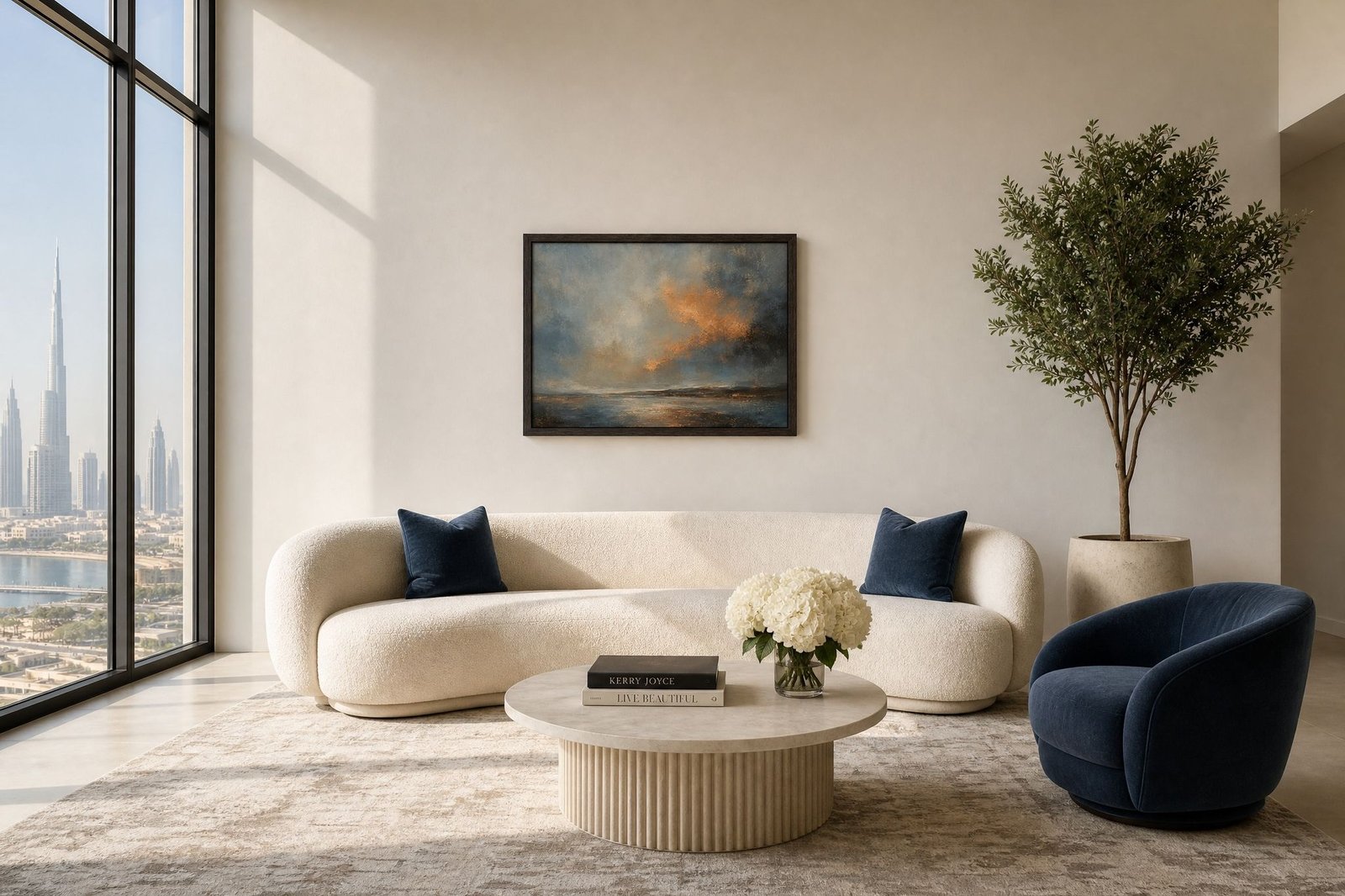
Desert daylight is unusually honest
Dubai daylight is intense for most of the year, and it does not forgive weak art. A print with a thin palette or a washed-out finish that would read as soft in northern light can look bleached out entirely once it sits across from a wall of glass in Dubai's midday sun. Colour that looked rich on a screen or in a showroom can flatten fast under this much light.
The practical response is to choose work with real depth of tone rather than pale, tentative colour. Deep taupes, charcoal, ochre, and warm amber hold their character under strong light in a way that pastel or washed palettes do not. This is one of the reasons tonal abstracts and warm-toned seascapes do so well in UAE interiors: they are built to carry weight in bright rooms, not just in gallery lighting.
Glazing and UV are a real consideration
Many Dubai homes, from Downtown apartments to villas along the coast, have glazing that lets in significant UV exposure for most of the day. That matters for anything hung in direct or near-direct sun. Ask about UV-protective glazing options for any piece that will sit opposite floor-to-ceiling windows, and think about orientation before you commit to a wall. A west-facing wall in a Dubai home takes a different kind of light than an interior wall away from the glass, and the artwork should be chosen with that exposure in mind.
This is a case where getting good advice before ordering saves more than it costs. It is worth a conversation before committing to a large-format piece for a wall that gets hard afternoon sun.
Double-height walls and oversized formats
Dubai villas and many apartment buildings have a habit European and American homes rarely do: real double-height space, stairwells that run two storeys, and entry walls that soar well past the ceiling height a smaller piece was designed for. These walls are unforgiving. A modestly sized piece on a six-metre wall reads as an afterthought, not a decision.
The right response is scale, deliberately. Oversized formats exist for exactly this reason, and a single generous piece, something in the register of an Amber Dusk Seascape at a large format, will do more for a soaring entry or stairwell than a cluster of smaller pieces ever could. If you are furnishing a villa with genuine double-height volumes, plan the art at the same time you plan the furniture, not after.
Art against skyline views and floor-to-ceiling glazing
A lot of Dubai living rooms compete with their own view. Floor-to-ceiling glazing looking out at the Burj Khalifa, the Marina, or the coastline is a strong visual anchor in its own right, and art hung nearby needs to hold its own rather than fight it. The instinct to choose something bold and literal, a skyline print to match the skyline outside, usually backfires. Two competing statements in one sightline read as noise.
The better approach is tonal. A quiet seascape or abstract picks up the same warm light the skyline view is already giving the room, and lets the window remain the room's one loud statement while the art does quieter work nearby. This is also why interior walls perpendicular to the glazing, rather than walls directly opposite it, are often the stronger place to hang a considered piece: the art gets its own moment instead of competing with the view for attention.
Palettes that hold in warm light
Across the projects we have done in Dubai and the wider UAE, certain palettes come back again and again because they hold their character under this specific light. Warm neutrals, taupe, sand, soft charcoal, work well because they sit close to the tones already present in most Dubai interiors, in the stone, the joinery, the natural materials used throughout the city's residential architecture. Amber and warm ochre tones read particularly well against golden-hour light, which most Dubai homes get generously through the winter months.
Cooler, paler palettes are not off the table, but they need either lower light exposure or stronger surrounding contrast to avoid looking washed out. This is a case where seeing the piece photographed in a real interior, the way every piece in our collection is shown, matters more than seeing it on a plain background.
Villa versus apartment
Villas and apartments in Dubai and across the UAE ask for different things from artwork. Villas tend to have taller ceilings, more wall area per room, and multiple long sightlines, hallways, staircases, double-height entries, that reward planning art across the whole home rather than room by room. Apartments, especially in towers with strong skyline or waterfront views, tend to have fewer walls and more competition from the glazing itself, which argues for fewer, better-chosen pieces rather than filling every available wall.
Neither is more or less demanding to get right. Both benefit from treating the art plan as part of the interior design brief from the start, not as a finishing touch added once the furniture has arrived.
Start with the light in your room
Before choosing a piece, stand in the room at the time of day it gets the most direct sun and look at what the light is doing to the walls already there. That single observation, more than any trend, should guide the palette and scale you choose.
Browse the full collection at studiosakaia.com/artwork, including pieces like the Amber Dusk Seascape built for exactly this kind of room, or enquire and tell us about your wall, your light, and your view.