
The two-thirds rule
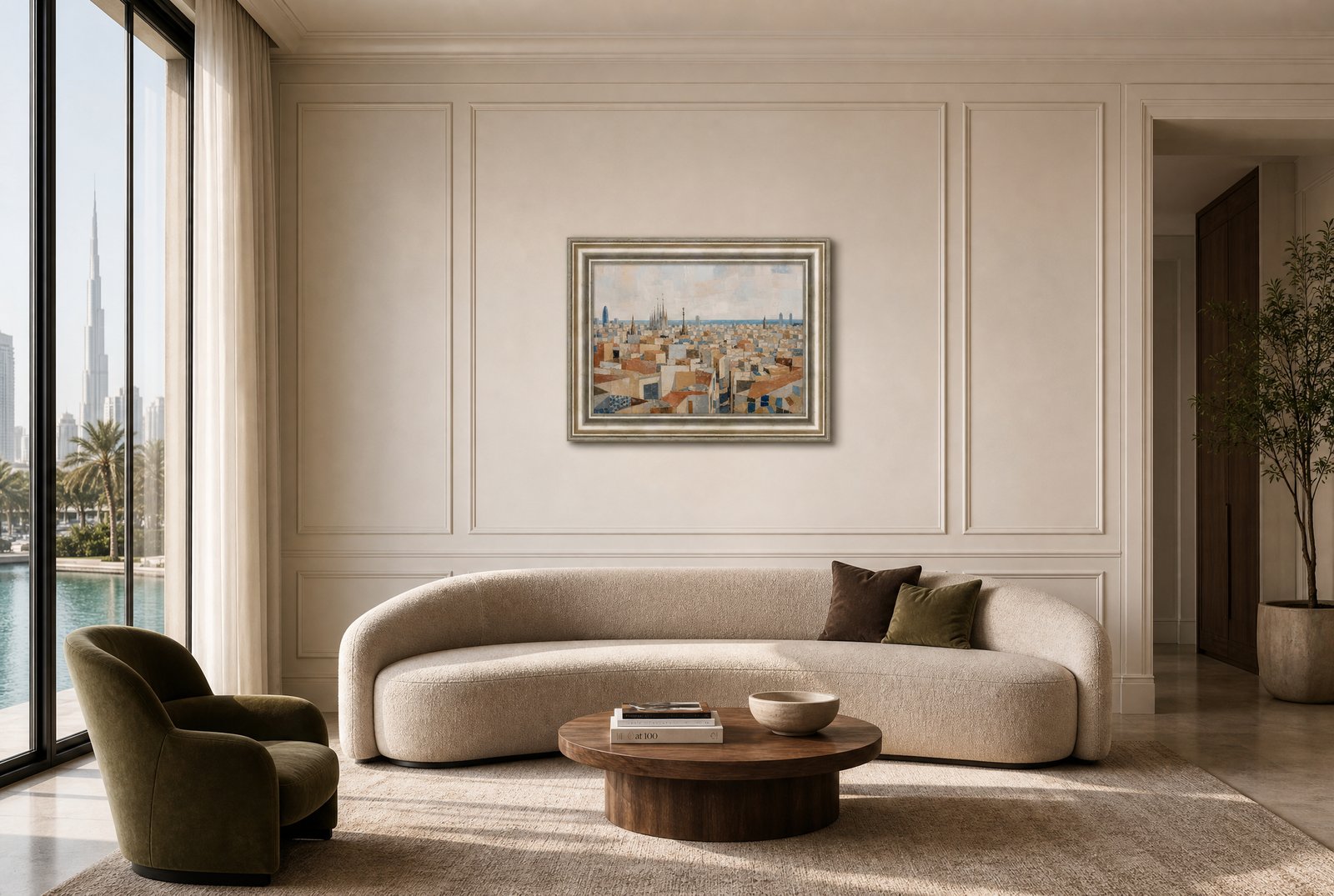
Measure the width of your sofa. The artwork or grouping above it should span roughly 60 to 75 percent of that width. Go narrower and the piece looks stranded, floating above the seating rather than belonging to it. Go wider than the sofa itself and the composition crowds the wall instead of anchoring it.
If your sofa is 240cm wide, you are looking for artwork, frame included, somewhere between 145cm and 180cm across. That might be one large piece, or a pair hung close enough together to read as one unit. The total footprint is what matters, not the size of any single frame.
The gap above the sofa back
Height matters as much as width. Leave 15 to 30cm between the top of the sofa back and the bottom of the frame. Closer than that and the artwork feels stacked on the furniture. Further than that and the two elements stop talking to each other, each floating in its own part of the wall.
The gap tightens or loosens with ceiling height. A lower ceiling suits the smaller end of that range, 15 to 20cm. A generous ceiling, common in newer Dubai apartments and villas, can carry 25 to 30cm without the wall feeling empty above the sofa.
Eye-level centres, not wall centres
The mistake almost everyone makes without realising it is centering the artwork on the blank wall rather than on the seating below it. A wall runs floor to ceiling, but a room is experienced by people sitting or standing near the sofa, and their eye level sits lower than the geometric centre of most walls.
The better reference point is roughly 145 to 150cm from the floor to the centre of the artwork, standard eye-level convention adjusted down for a room where people are usually seated. If that number lands close to the 15-30cm gap above the sofa back, you are in the right zone. If your ceiling is unusually high, trust the sofa relationship over the wall relationship.
Landscape formats work with the seating
A sofa is a strong horizontal line. Furniture and art either agree with that line or argue with it, and the argument rarely wins. A landscape-format piece, wide rather than tall, sits comfortably above seating because it echoes the line already established by the furniture. A single tall vertical piece can work in a narrow gap between windows, but directly above a long sofa it tends to look like it ended up there rather than being chosen for the spot.
This is why landscapes, wide seascapes and horizontal abstracts are the pieces we reach for most often above sofas. Barcelona Rooftops is a good example: a wide, calm horizon that sits happily over a curved sofa without competing with it.
When a pair works better than one piece
A single large piece is the simplest solution and often the right one. A pair earns its place when the sofa is unusually long, when the wall has an interruption like a window, or when you want quieter visual rhythm rather than one dominant statement.
Treat a hung pair as one object. Keep the gap between the frames tight, around 5 to 10cm, so the eye reads them together. The combined width, including that gap, is what you measure against the two-thirds rule.
The two mistakes we see most
Too small. This is the most common fault by far. A single 60cm frame above a 280cm sofa reads as an accessory, not the anchor the room needs. When in doubt, size up. A generous piece with a quiet subject will always look calmer than a small piece straining to fill a wall it was never sized for.
Too high. This mistake follows from centering on the wall instead of the sofa, leaving a gap that makes the arrangement feel disconnected, as if the art and the furniture belong to two different rooms.
Both are easy to avoid once you measure first and choose second: sofa width, two-thirds rule, 15-30cm gap, then pieces that fit that span.
Bringing it together
If you are staring at a bare wall above your sofa right now, measure the sofa, take 60 to 75 percent of that width as your target span, and mark a point 15 to 30cm above the sofa back for the centre of the artwork rather than centering on the wall itself. Then look for a landscape-format piece, or a close pair, whose palette already lives somewhere in the room.
If your project involves more than one room, our trade team works through exactly this kind of sizing across a full floor plan, so every wall in the home follows the same logic.
Browse the collection at studiosakaia.com/artwork, or enquire with your sofa dimensions and we will help you find the right size and piece for that wall.