
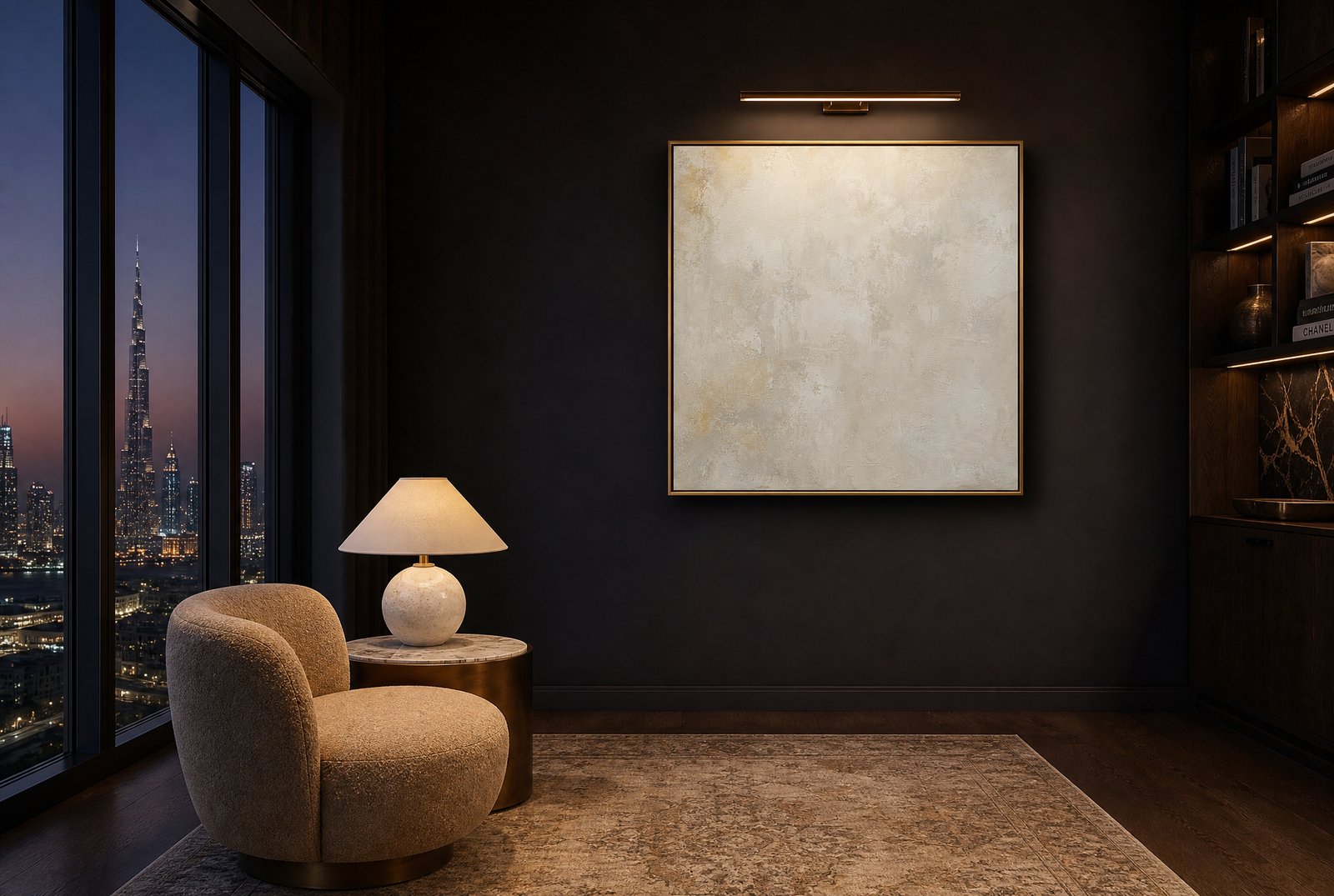
A room is lit by what sits below head height. The single ceiling fixture, the switch by the door that most people reach for first, is the one source that reliably makes a room worse, and turning it off is the fastest change you can make to how a space feels after dark.
The phrase people type into a search bar is how to light a living room, and most of the answers are shopping lists. The mechanics matter more than the fixtures. A room lit by one bright source overhead reads as a place you pass through: a corridor, a waiting area, a lobby before anyone has arrived. The same room lit by three or four low, warm sources reads as a place you stay. Nothing else in the room has changed. The furniture, the palette, the art are all identical. Only the height and number of the light sources are different, and that difference is most of the effect. It is also the most common lighting mistake we see at handover in Dubai: a set of builder-installed ceiling downlights at 4000 K, run on a single switch, doing the entire room's lighting on its own.
Why the overhead flattens a room
Light from a single point on the ceiling falls on everything at the same angle and roughly the same intensity. It erases shadow, and shadow is what tells the eye about depth, texture, and the shape of things. A boucle weave, the grain of oak, the voids in a piece of travertine all depend on raking light to register at all. Under a flat overhead they go quiet. The room becomes a set of surfaces at even brightness, which is the visual signature of a space built for function rather than for living: the supermarket, the office, the lift.
Richard Kelly, the lighting designer who shaped how the mid-century masters lit their buildings, split light into three jobs. Ambient luminescence, the general fill that lets you move safely through a space. Focal glow, the pool of brighter light that draws attention to one place, a table, a chair, a page. And play of brilliance, the small points of sparkle, a flame, a filament, a glint off metal, that keep the eye interested. A single overhead delivers only the first, badly, and none of the other two. A well lit room runs all three, and almost all of that work happens below the height of a standing person.
Below the head
The rule worth holding is that the useful light in a room sits below eye level, and the eye level that matters is a seated one. You are lying on the sofa, sitting at the table, reading in the chair. Light that pools at that height is flattering and calm. Light that arrives from above the head is the opposite.
In practice that means table lamps whose shades sit with their lower edge around 105 to 110 centimetres from the floor, so the bulb is near seated eye level and the shade throws a pool of light down and out rather than a glare across the room. It means a pair of lamps or sconces flanking the bed instead of one fixture above it, so the light is even and low on both sides. It means a floor lamp in the corner, ideally one that throws some light up onto the ceiling, because a lit ceiling plane lifts the whole room and softens the edges. Aim for at least three of these low sources in any room where people actually sit, and place them at the corners of the space rather than the centre, so the light describes the size of the room instead of collapsing it to a single bright middle.
The overhead is not banned. It earns its place on a dimmer, run low, as one layer among several, or reserved for the times you need flat working light to clean or to find something. What it should never be is the default evening setting, the switch you hit on the way in and leave at full.
One temperature, and a dimmer on everything
Two settings decide whether the layers read as warm and domestic or cool and institutional, and both are usually wrong out of the box.
The first is colour temperature, measured in kelvin. Warm light sits around 2700 K, the colour of late afternoon and of an incandescent bulb. Cooler light climbs toward 3000, 4000, and beyond, into the blue white of an office. A home wants 2700 K almost everywhere, and the single most common lighting mistake in a new apartment is a set of bulbs at 3000 or 4000 K that make the whole place feel like a showroom. The fix costs the price of new bulbs. Match every bulb in a room to the same warm temperature, because a room lit at two different temperatures reads as an error the eye notices before the mind can name it. In a Dubai new-build, this is usually the ceiling downlights: the developer-standard fixture is almost always 4000 K, and swapping those bulbs for 2700 K is the single cheapest change most handover apartments here can make.
The second is dimming. Every source that stays on in the evening should be on a dimmer, and the room should have a low setting it drops to after dark. Full brightness is for the afternoon and for work. The evening version of a room is quieter, dimmer, and lit almost entirely from below. A room you can dim is a room with more than one mood, which is the difference between a space that performs one job and a space you want to be in at different hours.
What this has to do with scale
Light and scale are the same problem seen twice. A lamp that is too small throws a pool too small to matter, and a room dotted with under scaled lamps stays dark between them however many you add. The lamp on a side table should feel a little larger than instinct suggests, tall enough that the shade reaches seated eye level, wide enough that the pool of light it throws actually covers the chair beside it. Scale is the subject of its own piece, but it starts here: a light source too small for its position is a light source that does not do its job, and the room reads as dim no matter how many you install.
The test
Turn off the overhead. If the room still works, if you can read in the chair, see your way across the floor, and the space feels resolved rather than gloomy, the low light is doing its job and the overhead was only ever a crutch. If the room collapses into darkness the moment the ceiling light is off, the low layer is missing or under scaled, and no amount of overhead brightness will fix the flatness it causes.
Start with two changes, both cheap. Put the main rooms on dimmers and drop them low in the evening, and replace any cool bulbs with warm ones at 2700 K. Those two decisions carry most of the effect, and neither requires buying a single new lamp. The lamps come next, placed low and at the corners, until the room is lit from below the head and the switch by the door has become the one you rarely use.